

Marjan – a forest park and hill above Split
Location: SplitDifficulty: EasyDifficulty rating: K1, T1, VR1
A Testimony of a Time
*** On July 8, 2025, Split was struck by the strongest storm in its recorded history. “Microbursts” and waterspouts hidden within a supercell storm brought destructive winds that showed particular ferocity at several points. That morning, a device on the ferry Petar Hektorović recorded wind gusts of 212 knots in the city harbor — approximately 390 km/h. Experts claim this is impossible, but the device did not invent the figure, and the sheer force of the wind snapped mooring lines and pushed the ferry into other ships, one of which was sunk.
Some locations mentioned in this text suffered destruction from which they will take decades to recover. Sustipan and Zvončac were significantly hit with many downed trees, while the bay of Bene on Marjan suffered total destruction. One of the most beautiful bays, a legendary destination for generations of Split’s citizens, is now only a trace in the infinity of our memories. There was never a “right time” to document it perfectly, as all secondary activities there always took a back seat to simply enjoying it.
Only now, when Bene is practically gone, does the regret for a lack of diligence remain. Nevertheless, even this meager collection of photographs, captured in passing, will serve as a testimony of a time we hope our descendants will be able to experience again.
***
Looking at Split from a distance, one could describe it as a city between two hills. And while the hill to the east is of a more recent date and not something we wish to write about here, the hill to the west is the most valuable thing this city possesses.

How to describe the indescribable?
On the other side of the center, a clear line is drawn where the city’s color abruptly transforms from urban to green. Miles of green, framed by the deep blue of the sea… To say it is the most beautiful place in the “most beautiful city in the world” would not be a lie, but it would feel sparse and incomplete.
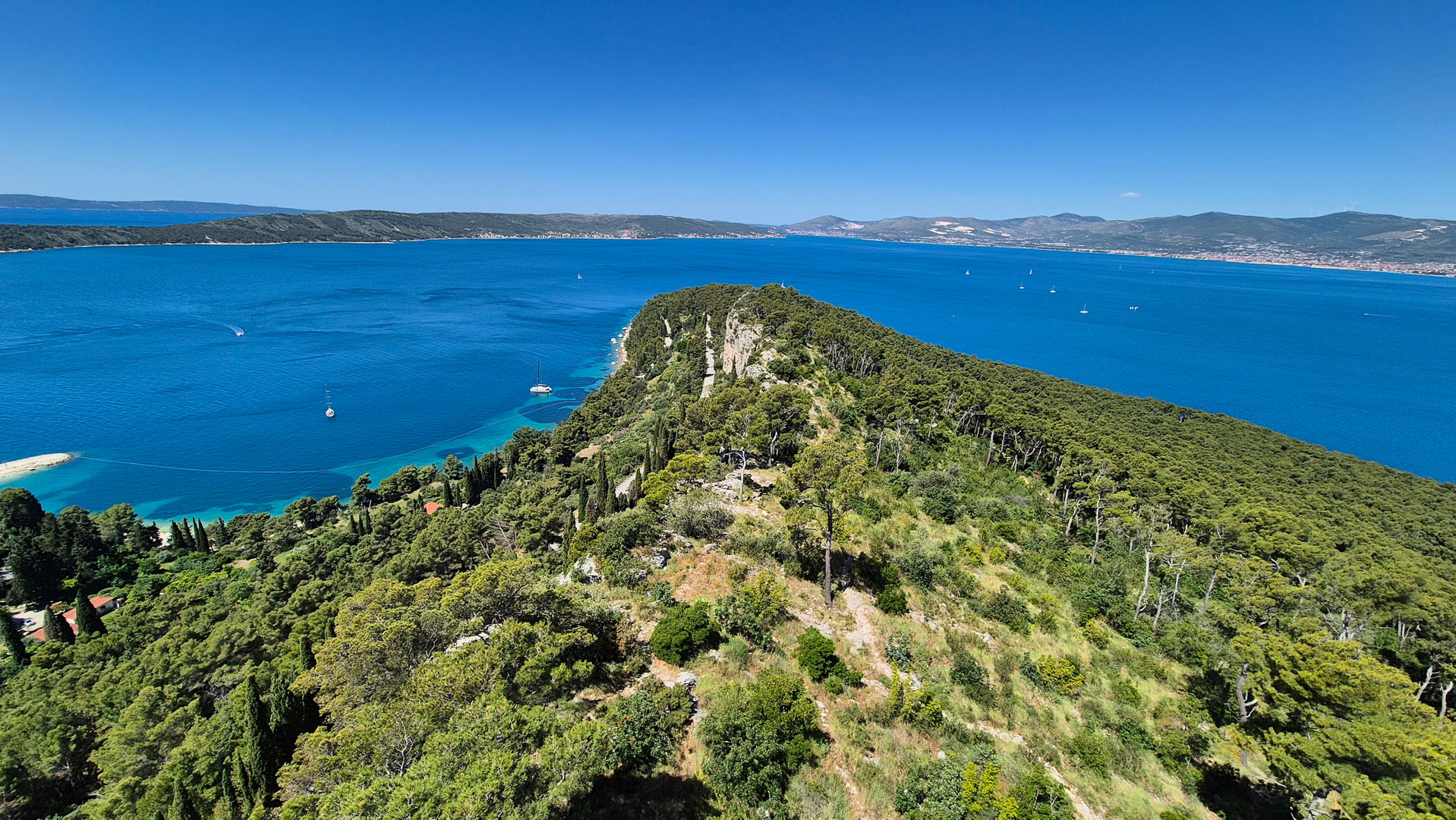
If you are a newcomer and call the hill Marjan, older Split natives will gladly correct you, saying the proper way is “Merjan,” even if they rarely use that form themselves anymore.
The city and the hill have formed an unbreakable bond since time immemorial. The vistas of the city and the hill have changed through history, but their interconnectedness — spatial and otherwise — has remained a constant to this day.
In winter, when you want to hide from the Bura wind and soak up some sun, you pass through the Marjan Tunnel, turn right, and wherever you stop, you will be shielded from the cold. The beauty you witness will enchant you like a siren’s song, so strongly that you’ll want to stay forever.

In summer, when you seek shelter from the unbearable heat, you find refuge in the shade of century-old pines or jump into the crystal-clear, yet incredibly blue sea.

If you are an “ozone addict” craving fresh forest air, there is nothing more beautiful than a walk through the woods after the rain. After heavy rainfall, at Prva Voda you will see dozens of springs and vrulje (underwater springs) returning water to the sea. In extreme cases, you will even see waterspouts erupting from the sea!
The Split Riva is gorgeous, but the most beautiful place to drink your morning coffee is undoubtedly Prva Vidilica (The First Viewpoint). For tourists, it is an essential location for panoramic photography. Easily accessible, almost in the city, yet distinct and special.
If you want a view of “the whole world”, you climb a bit higher, to “Zastava” (The Flag), at the highest peak, Telegrin. Some might stop at the Church of St. Nicholas on the way up to admire the Mediterranean rhapsody in stone. Others will stay by the zoo, on a bench in the deep shade, enjoying the gentle caress of the Maestral breeze or drinking cold water from a stone tap (špina).
Lovers of physical activity — walking, running, cycling — will find hundreds of paths on this side of the center: short and long, asphalt and stone, dirt and grass, forest and coastal… Those wishing to kayak, swim, or cliff-dive will certainly not be disappointed.
If you prefer outdoor gyms or tennis, Marjan is the ideal place. The same goes for adrenaline junkies: mountain biking trails wait hidden deep in the forest.
Perhaps other places offer all this, so let’s move on to those with more specific demands. Suppose you are a climber seeking cliffs with the most beautiful views imaginable, accompanied by the scent of the sea, pines, and aromatic herbs — lavender, immortelle, heather, sage, rosemary, or all of them at once. Perhaps you’d like to hide your belongings in the shade of agaves and refresh yourself with figs straight from a nearby tree? No problem; this place on the other side of the center provides it all.
And deep-water soloing above the sea, where you can’t wait to make a mistake just to fall in and take a swim? Yes, that goes without saying!
Beautiful bays, beaches, and rocks immersed in the sea provide a scenography that transcends the imagination of film set creators. This is why film crews come here, capturing the site with lines like: “I have a picture in my head of a place I don’t know if it’s real, but it has a feeling and the feeling’s real… This place is overwhelming! It’s amazing how easy humans can get used to even something spectacular…”

For all those seeking contemplation, meditation, and relaxation, there are hundreds of more- or less-hidden corners on Marjan. Hermits recognized this place hundreds of years ago and carved their hermitages into the cliffs.

Century-old small churches and chapels, the earliest Midnight Mass in the world set against a purple winter sunset, the hypnotizing song of crickets in the summer heat, and joyful birds in the spring…

The scent of resin, Mediterranean vegetation in its most beautiful form, dry-stone walls, stone stairs and fences, imposing cliffs, stone sculptures, spectacular views of the sea, the islands, and the “most beautiful city in the world”… How to describe the indescribable?
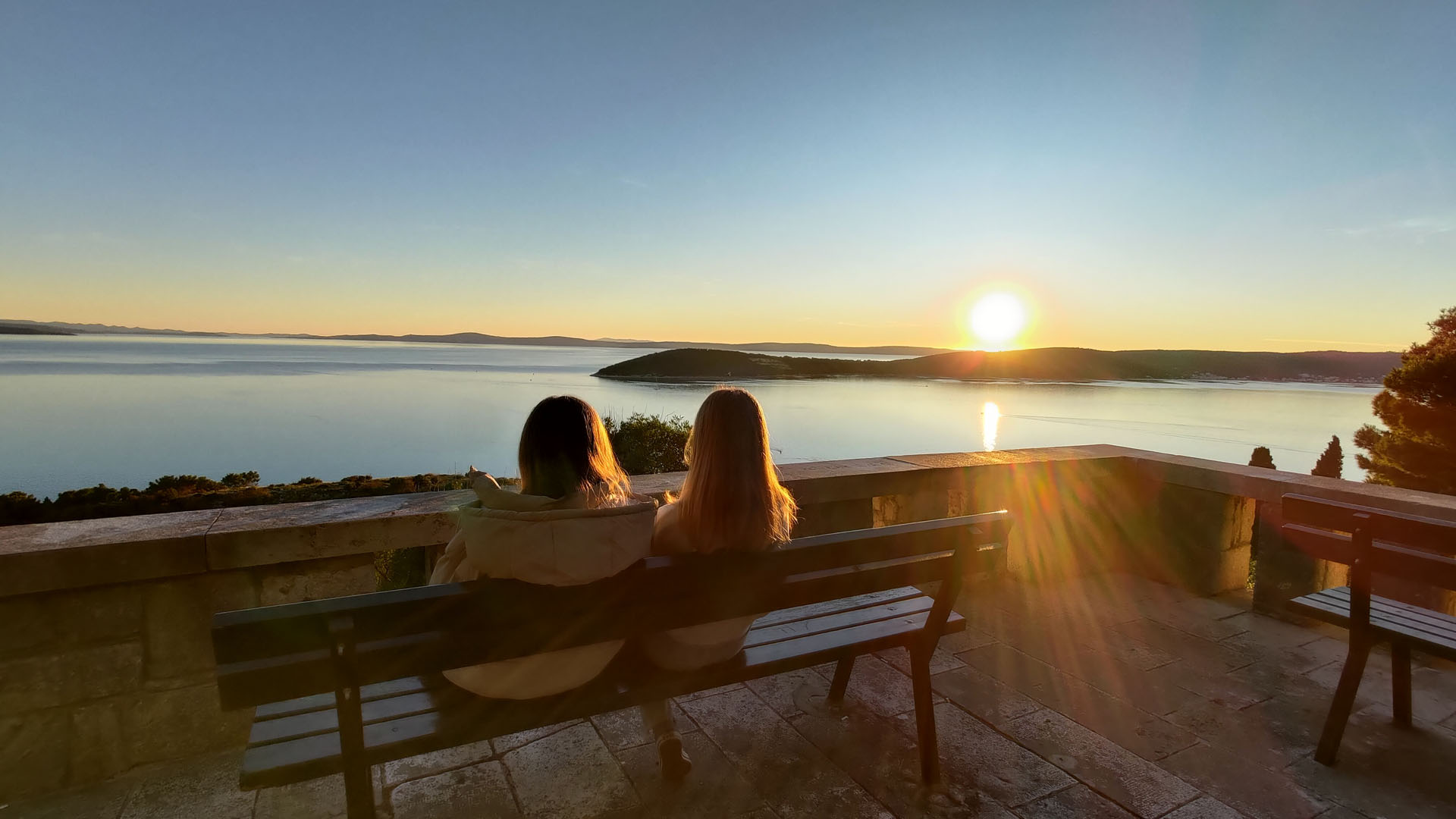
Some have tried through song, others through photography and the paintbrush. Merjan is an eternal inspiration.
To most tourists, Marjan is a viewpoint or a backdrop, depending on where they aim their lenses. To them, it is the hill on the other side of the center. To Split natives it is that too, but they experience it in a completely different way. It is a hill of a multi-layered structure — and we don’t just mean geological. To penetrate those layers, you must live it. You must first understand Split, its mentality, and its lifestyle — today and throughout history.
Marjan represents a thousand years of labor by peasant farmers on this beautiful but harsh karst, salted by the sea and crisscrossed by countless, now overgrown, dry-stone walls. Marjan is the paths trodden by donkey hooves, the vows of sailors departing for distant seas from which they might never return, the emigration to the faraway Americas, the asceticism of hermits, defiance and patriotism — the “dear tricolor” flag as a symbol of resistance to occupiers, sung about and raised during times of greatest repression… An intertwining of history, human aspirations, suffering, and hope… The essence of the Dalmatian spirit, told and brought to life through every carved and uncarved stone…
And so, how to describe the indescribable? Impossible. That is why Marjan must be experienced, preferably from different perspectives in countless iterations…

How to tour Marjan?
Best done slowly and in several visits!

1. Northern Gate, 2. Prva Voda, 3. Bene, 4. The Institute, 5. Southern Ramp, 6. Kašjuni, 7. Šantine Stine, Sv. Jere, 8. Observation Tower, 9. Sedlo, 10. Zastava, Telegrin Peak, 11. Botanical Garden, 12. Zoo, 13. Northern Ramp, 14. Prva Vidilica, 15. Tomića Stine, 16. Sustipan, 17. Jadran, 18. Zvončac, 19. Meštrović Gallery, 20. Ježinac, Obojena, 21. Meštrović Kaštelet, 22. Vila Dalmacija
If you are on a short visit and want to see the most, our recommendation is the following route:
Prva Vidilica – Church of St. Nicholas – continue along the Marangunić Promenade – Botanical Garden – rejoin the Marangunić Promenade – Sedlo – Observation Tower – Church of Sv. Jere with the hermitage – Karepić Tower – return via Sedlo – the summit of Marjan, Telegrin (Zastava) – descent to the Zoo – return to Prva Vidilica.
This route is about 6.5 km long with around 200 m of elevation gain. That does not include the climb up to the starting point at Prva Vidilica. To see it all, taking it slow with plenty of photo stops and breaks, plan for half a day.
By all means, plan a visit to Zvončac and Sustipan, and a stroll along the sea to the bay of Ježinac (Obojena). You can drive to Zvončac, but you can also start the same walk in reverse, from Ježinac, where parking is also available.
Among the locations that remain a must-visit is the northern side of Marjan (at least as far as Bene), whose entrance gate is also reachable by car.
Glossary, points of interest, and locations on Marjan
Size
Marjan covers about 340 ha, half of which is pine forest. Its length is about 3.5 km, with a maximum width of 1.5 km.

Merjan
Today’s name emerged in the 19th century as a modification of the older form Merjan, still preserved among older Split natives.
Marulianus
One of the Roman names for Marjan.
The legend of the bare hill
You will often hear it said in everyday speech that “Marjan used to be bare.” Advocates of construction on Marjan especially love to highlight this — they would happily see the hill stripped of its forest, with buildings reaching all the way to the summit. Yes, there were periods when Marjan was without forest, but exclusively through human neglect and destruction. Before that, Marjan had been covered in woods. It is believed to have been forested as far back as Roman times, since on the Roman map “Tabula Peutingeriana” from the first century, a temple of the goddess Diana is marked on the site of Marjan. Diana was the goddess of the hunt, associated with wild animals and forests. Even if we dispute that as evidence, we know it was forested in the Middle Ages, because the 1312 Statute of the City of Split forbade the cutting of trees on Marjan.
Reforestation of Marjan
The “reforestation of Marjan” refers to the most recent effort, which began in 1852 with the planting of mostly Aleppo pines. After years of neglect and prolonged soil erosion, pines were chosen as the base species — they prepare the soil and create the conditions for planting other species.

The initiator of this campaign was Prof. Juraj Kolombatović, a Croatian naturalist and founder of the Marjan Society (1903), an association whose purpose was to establish lasting care for the preservation of Marjan.
The volcano legend
The theory of Marjan as a volcano resurfaces every now and then. Its main basis is the sulfur water springs, particularly on the eastern side of the hill, where they were tamed by the construction of a spa.
Prva Vidilica

This is the iconic spot from which the view stretches across the entire city.

A café and favorite gathering place in fair weather, reached either through one of the lanes of Varoš or via the stone stairs from Tomića Stine. You can even drive up from the direction of Spinut, but parking is so scarce that it is easier to win a lottery than to find a spot. For some, this is the farthest point they reach on Marjan — but Marjan only really begins here.

The northern side
The northern side is totally different from the southern. Larger and more wooded, for most people it is the starting point for a visit to Marjan. It is the logical choice whenever it is not winter and the Bura is not blowing. If you arrange to meet someone on Marjan without specifying where, you will most likely find them at the Northern Gate.

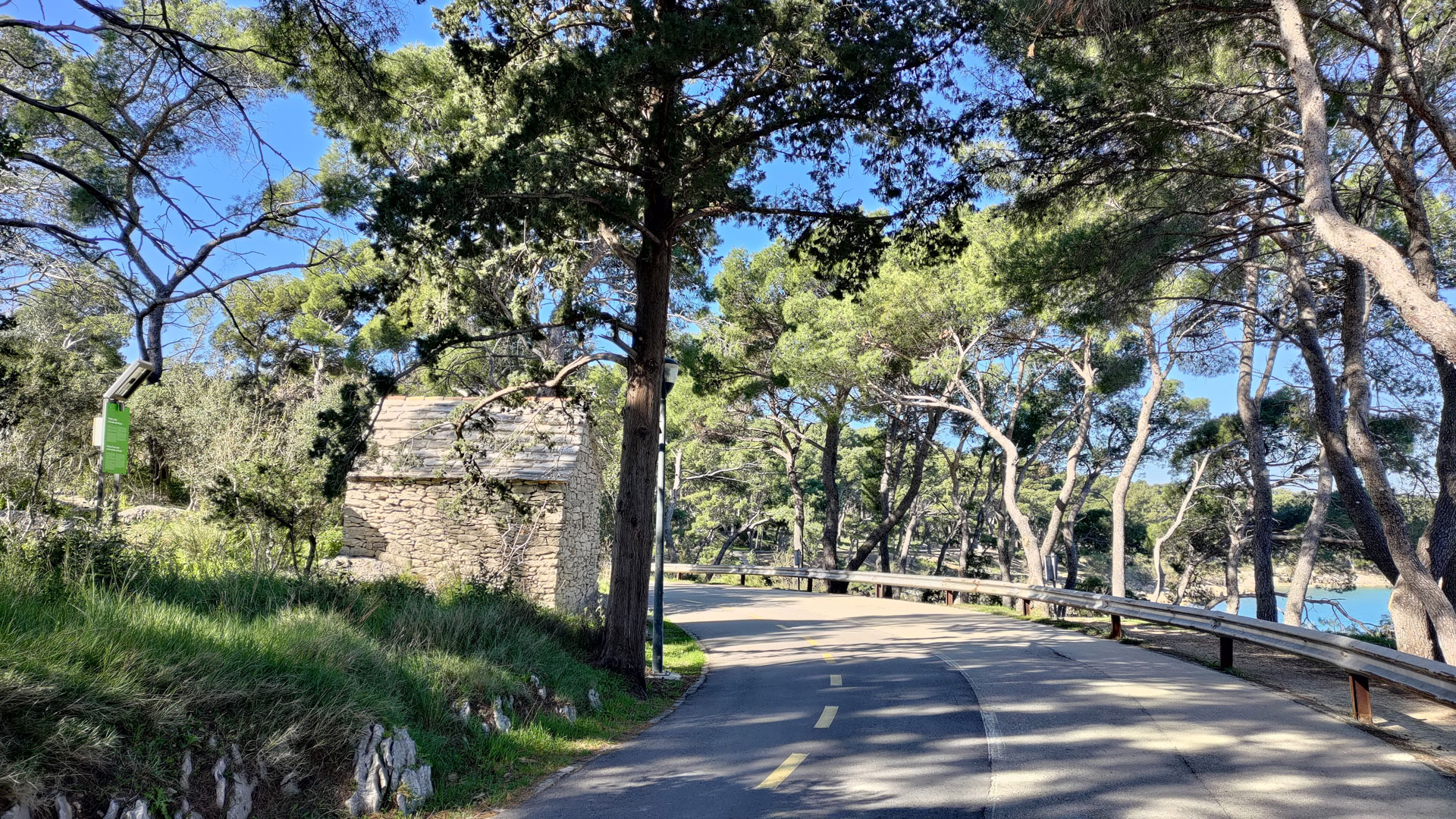
Northern Gate (Sjeverna kapija / Marjanska vrata)
Marjanska vrata, Sjeverna kapija, or simply “the gate,” also known as Spinutska vrata after the eponymous neighborhood on the northeastern side of Marjan, is the main entrance to the hill. Expect the heaviest crowds here — cyclists, runners, walkers, children learning to walk, pets… That crowd will mostly accompany you as far as Bene. In front of the gate is a free parking lot that fills up quickly, so the alternative is the parking area at the small harbor by Prva Voda.

The Northern Gate is also the start of the fitness trail; and immediately to the left, a climb leads up to the Fire Road, which runs parallel toward the west and joins the main path between Bene and the Institute.
Runners reckon it is 3 km from the start of the flat parking area in front of the Northern Gate to the Institute. That was the rough yardstick used before the era of smartphones.
Northern Ramp
Don’t confuse the Northern Ramp with the Northern Gate. The Northern Ramp is on the way up to the Zoo from the northern side. You will pass it several times if you happen to be looking for parking for Prva Vidilica.
Prva, Druga, and Treća Voda (First, Second, and Third Water)
In Split, you will often hear someone say they are going to Prva Voda. At Prva Voda is the first in a series of beaches on the northern side of Marjan. Did it get its name from that? No.

If you ask the average Split native about the names Prva, Druga, and Treća Voda, you may get different answers. Some will tell you it is tied to the old stone taps (špine / fountains) placed along the path. But then, where does that leave the first in the line of taps, halfway between Marjanska vrata and Prva Voda?

The northern side of Marjan has plenty of freshwater springs. Before the public water supply was built, people gathered water at these springs — and that is how the names were born. If you look at the locations of these “waters,” you will notice they are a kind of basin descending downhill to the sea. Along the parts of those basins where the road crosses, you will see drainage channels under the road, carrying torrents down to the sea. After heavy rains at Prva Voda, freshwater erupts on all sides, both on land and in the sea. After particularly heavy downpours, it is not unusual to see waterspouts erupting from the sea!
Lubinski Porat (Vrulja)
As mentioned, Marjan abounds in vrulje (underwater freshwater springs). Most of them are on the northern side. However, when people mention “the vrulja on Marjan,” they are usually referring to the larger, permanent one at Lubinski Porat at Treća Voda. A beautiful little bay, almost always in shade.

Bene
*** As mentioned in the introduction, on July 8, 2025, Split was struck by the strongest storm in its recorded history. The whole city was hit, and the bay of Bene most severely of all — it was completely destroyed. The photographs and text are of Bene as we remember it, and as it may one day be again.

Bene is the main bay on the northern side of Marjan. A beloved getaway with a café-restaurant, in the past also a children’s playground, tennis courts, exercise equipment, and a west-facing swimming area.

The bay was named after the old chapel of St. Benedict.

A concrete-and-stone beach with sand on the seabed and plenty of pine-tree shade is a special charm of Bene!
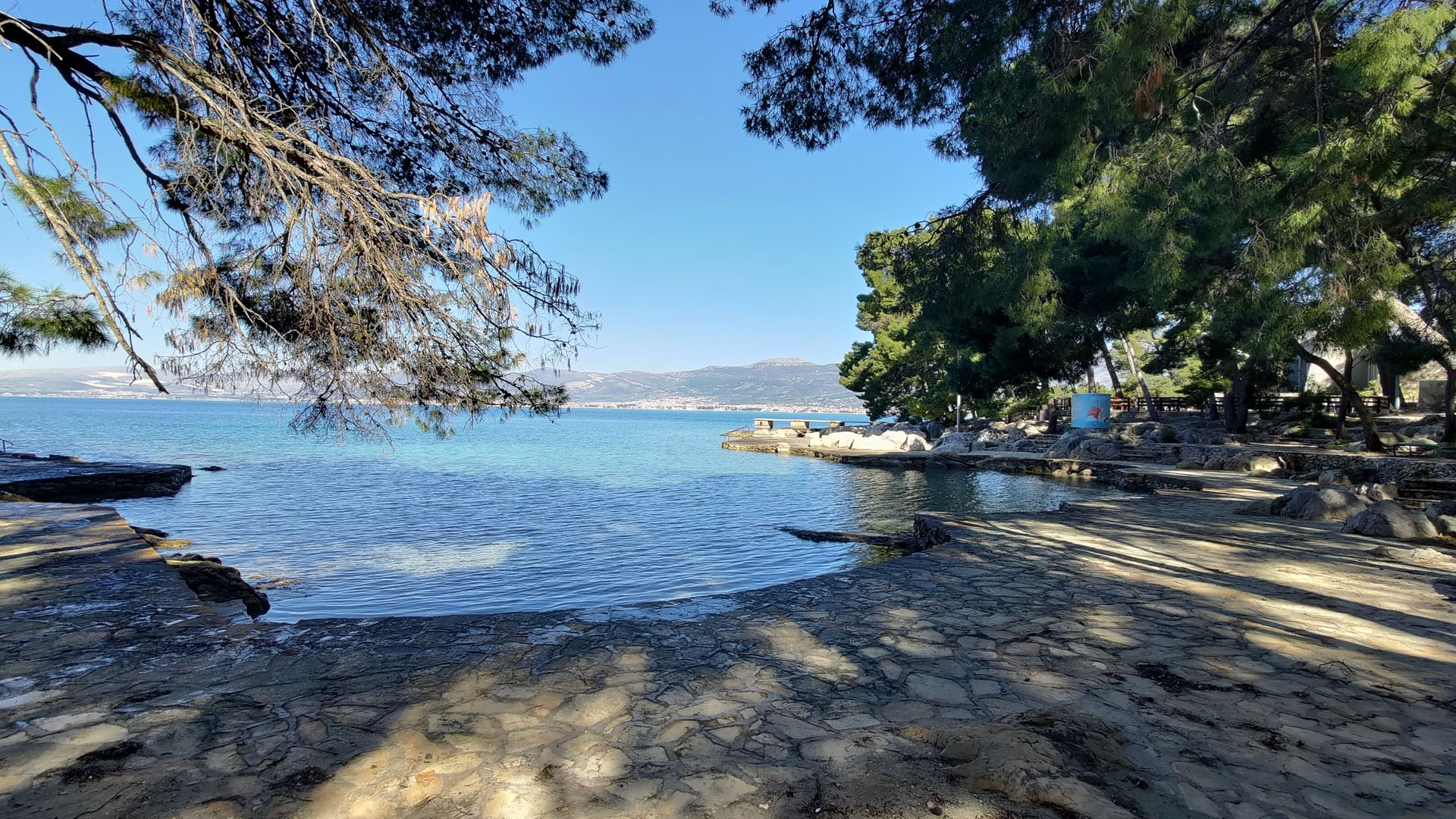
Bene is a destination in its own right. If you head to the northern side of Marjan, Bene is the natural goal. Expect plenty of people, especially on weekends and holidays — mostly families with children.
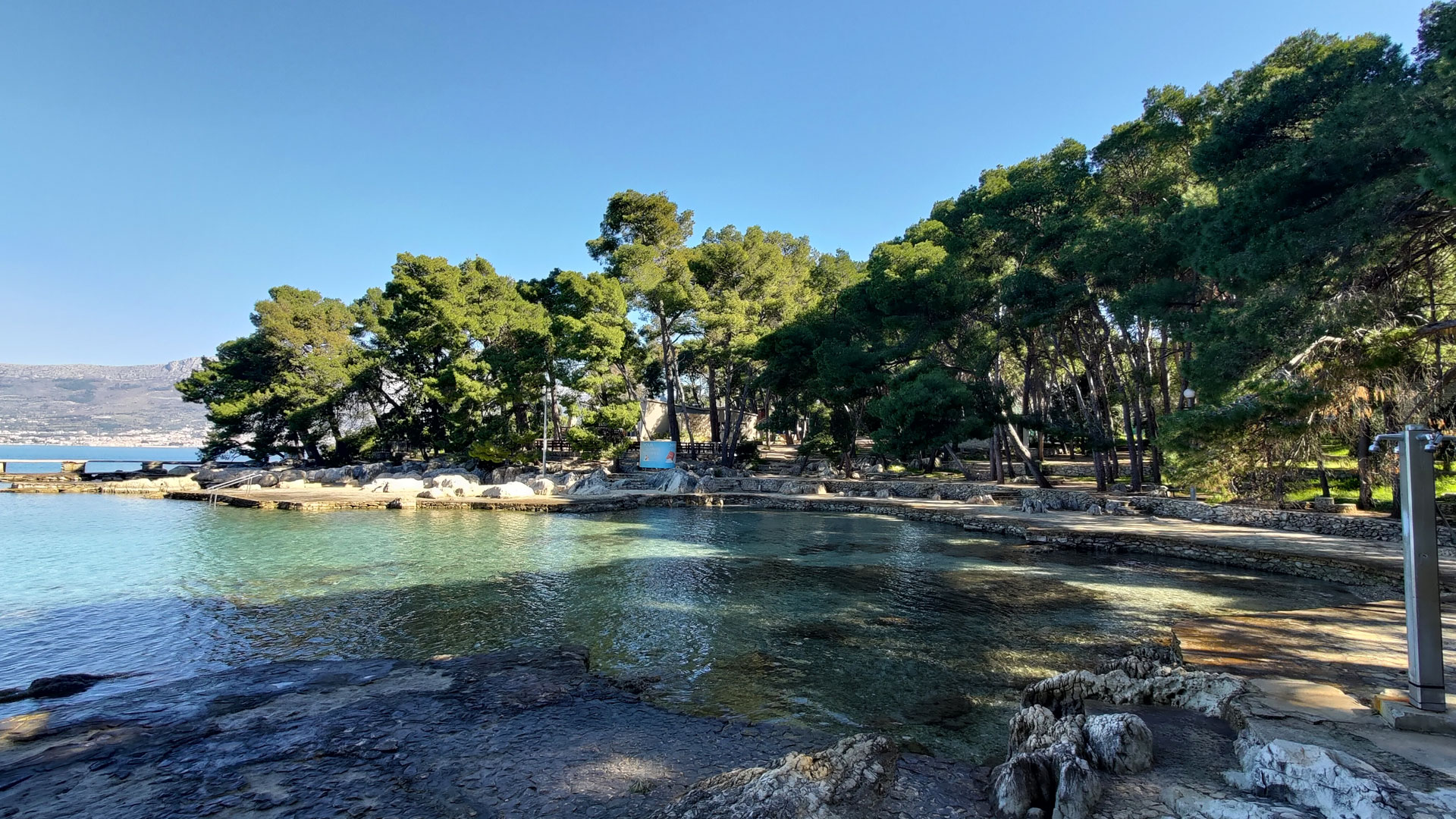
The area on the point just before Bene is called “the bunkers” by older locals, although the only preserved bunkers are at the top, on Girometta’s Path between Sedlo and the Cross.


For some, running all the way to Bene is a measure of being in some kind of shape. The turnaround point for the bus that arrives from the southern side of Marjan is also here.
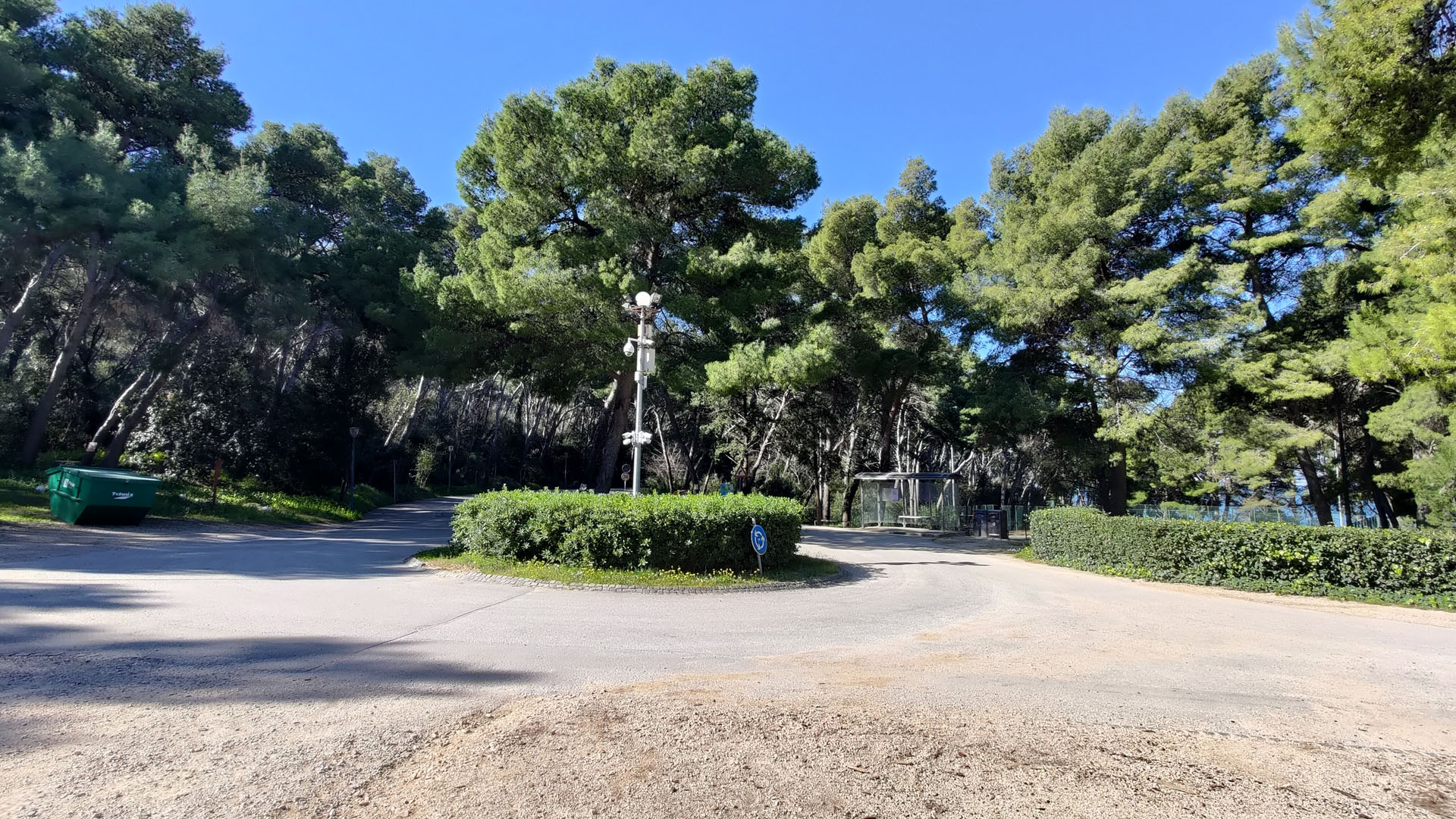
If you see cars here, those are people with permits. Permits were issued mainly to those with booked tennis times, but as with everything else around here, this is open to abuse. In any case, from Bene onward, expect to encounter the bus or the occasional stray car.
Sadly, Bene is also a matter of politics. As it lies on maritime public land, the county authorities grant the concession to the well-connected, often to the detriment of the city. Years of neglect by irresponsible, indifferent, and under-resourced concessionaires have left Bene looking run-down, unmaintained, and even devastated.
The Institute

The Institute of Oceanography and Fisheries, founded in 1930, is the westernmost point of Marjan. People usually run to the Institute and back. There is a bus stop here, and the beach at the point is a favorite swimming spot for everyone who avoids the conventional. Currents are strong and maritime traffic is constant, so be careful not to swim too far from shore.
The Institute is the point that, unless you have built up some speed on your bike, marks the start of the steep climb up toward the Southern Ramp.
Fire Road (Požarni put)
The stretch from the gate to Bene is often crowded. Cyclists, runners, walkers, foreign visitors, school P.E. classes, races… The Fire Road is the alternative for anyone who prefers to avoid the crowds on the northern side of Marjan.

From the gate, climb to the left and keep going uphill until you reach the road cut through for firefighting-vehicle access. The Fire Road is beautiful, because it runs through the densest forest of Marjan!
It runs parallel to the lower road and ends behind Bene, just before the Institute. From it, you can connect to countless trails both above and below. That is the beauty of Marjan — you can find a path on which you will not meet a soul. Just you and nature.

The southern side
The southern side is completely different from the northern. It is the logical choice when the Bura is blowing or when it is cold. This is the leeward side, and the sun here always feels warmer!

This is the side you choose if you want to enjoy spectacular views of the sea and the islands. Here you will find some of the most beautiful locations in the world, such as the Church of Sv. Jere, Šantine Stine, the “Southern Viewpoint”… A road closed to traffic climbs in switchbacks and continues past Sedlo to the summit of Marjan.
Below it lies one of the most beautiful bays — Kašjuni.
Southern Ramp
If there is a Northern Gate, this should be the southern equivalent. Instead of a gate, however, a ramp is set up here. This is the farthest point to which you can freely drive a car along the southern side of Marjan. Only permitted vehicles can pass through, or anyone when traffic is opened during works at the Marjan Tunnel. Next to it is a second ramp, on the road that climbs uphill along the southern side.
Marjanske skale (Marjan Stairs)

Marjan has plenty of stairs. That is why the traditional “Skalinada” (stair race) is run here. The most famous are the ones that climb from the direction of Matejuška up to Prva Vidilica, and those that lead from the “Zoo” to the summit of Marjan.

First Peak (Prvi vrh)
The First Peak is the one by the Zoo, at an elevation of 125 m. Here you will find the Meteorological Observatory building, a restaurant later converted into the Natural History Museum, and the Zoo.

In front of it is a stone tap (špina) where you can quench your thirst. Further to the west, a flat clearing holds children’s play facilities (the former “Indian Village”).

There is also a small outdoor stage where performances are held. This is the traditional venue for the May Day celebration, attended by thousands of Split natives.

The Zoo
The Zoo and the Natural History Museum opened in 1926. Two years later a marine aquarium opened — the first of its kind in this part of Europe. It was later converted into a terrarium. The first director and curator was Professor Umberto Girometta.

The Zoo stagnated for decades, to the point of facing closure. Because of inadequate conditions, most wild animals were distributed to other zoos, and only domestic animals remained. The Zoo barely survives today thanks solely to the selfless dedication of its director and staff, who are wonderful and utterly devoted to the project! Children’s workshops and other activities are held here, and the animals can be fed.

The Summit of Marjan — Second Peak, Veli križ, or Telegrin

This is the highest peak of Marjan, at 178 m. Its official name is Telegrin. There are two theories about the origin of the name. According to the one supported by several authors, the name comes from the Latin word “peregrinus” — “pilgrim.” The other, less common theory holds that the name Telegrin comes from a telegraph installed on the summit of Marjan during the Napoleonic era for communication.

The summit of Marjan is a plateau enclosed by a stone wall, with a 360-degree view (as far as the lush surrounding vegetation allows). Benches are set out for resting on the plateau, and its main feature is the Croatian flag.
Zastava (The Flag)
The flag at the summit of Marjan is the one from the song — “Mila trobojnica” (“Dear Tricolor”). It is always raised and visible from every part of Split.

The Cross
The Cross on Marjan was first erected in 1900. From then on, people also began calling the summit of Marjan “Veli križ” (the Great Cross). The Austro-Hungarian army removed it during World War I to prevent it from serving as a target. There was an initiative to reinstall it in 1927, but a new cross was not erected until 2013. It is made of white stone, 13 meters tall (10 m without the staircase base). It is positioned below the Telegrin summit on the western side.

Third Peak (Treći vrh)
The Third Peak lies on the western slopes of Marjan at an elevation of 148 m. The fire observation tower stands on it.
Fire Observation Tower
A new, modern tower was built in 2024 on the site of the old one.


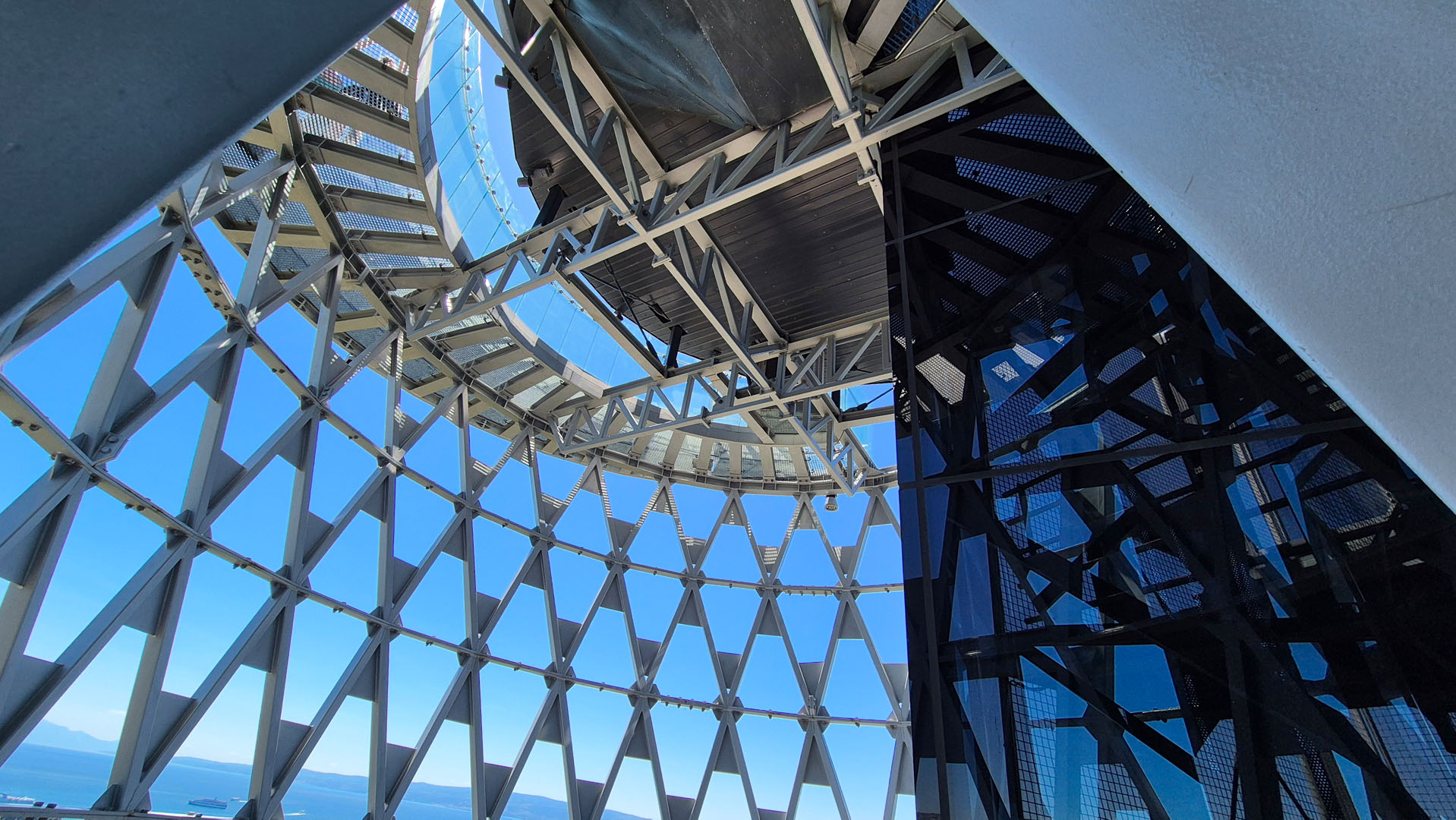
It is open to visitors free of charge, and offers one of the most beautiful views in the world!


Sedlo
Sedlo is a saddle and a junction of several roads and paths on Marjan. From here you can head east — to the left toward Telegrin Peak; along the middle path, Girometta’s Path, past the bunkers and on to Telegrin again; or right along the Marangunić Promenade toward the Botanical Garden and the Church of Sv. Nikole, and on to Prva Vidilica.

Heading west through the forest, you can go right along “Baba Marta’s Path” to the aforementioned fire observation tower and on to the Institute; or left to the southern side, toward the Church of Our Lady of Bethlehem and Sv. Jere, descending toward Kašjuni. From Sedlo, forest trails also lead north to Bene and south.
Botanical Garden
The Botanical Garden on Marjan is on the southern side, immediately above the Marangunić Promenade, on the stretch from the Church of Sv. Nikole toward Sedlo.

It was founded in 1951 and is managed by the Faculty of Science of the University of Split. After many years of neglect and decline, a revitalization and restoration project was launched a few years ago.

It was restored and reopened to the public in early 2025.


Marangunić Promenade
A popular path along the southern side of Marjan, leading from the Church of Sv. Nikole, past Sedlo, and down the southern slopes of Marjan. Two-thirds of the way toward Sedlo lies a well-known south-facing viewpoint, with another one below the fire observation tower and the Church of Our Lady of Bethlehem.

Šantine Stine

Šantine Stine are the cliffs below the Third Peak on the southern side of Marjan. They are best seen from the beach at Kašjuni and form the spectacular scenery of the entire area. To come to Split and not see this is a great omission!
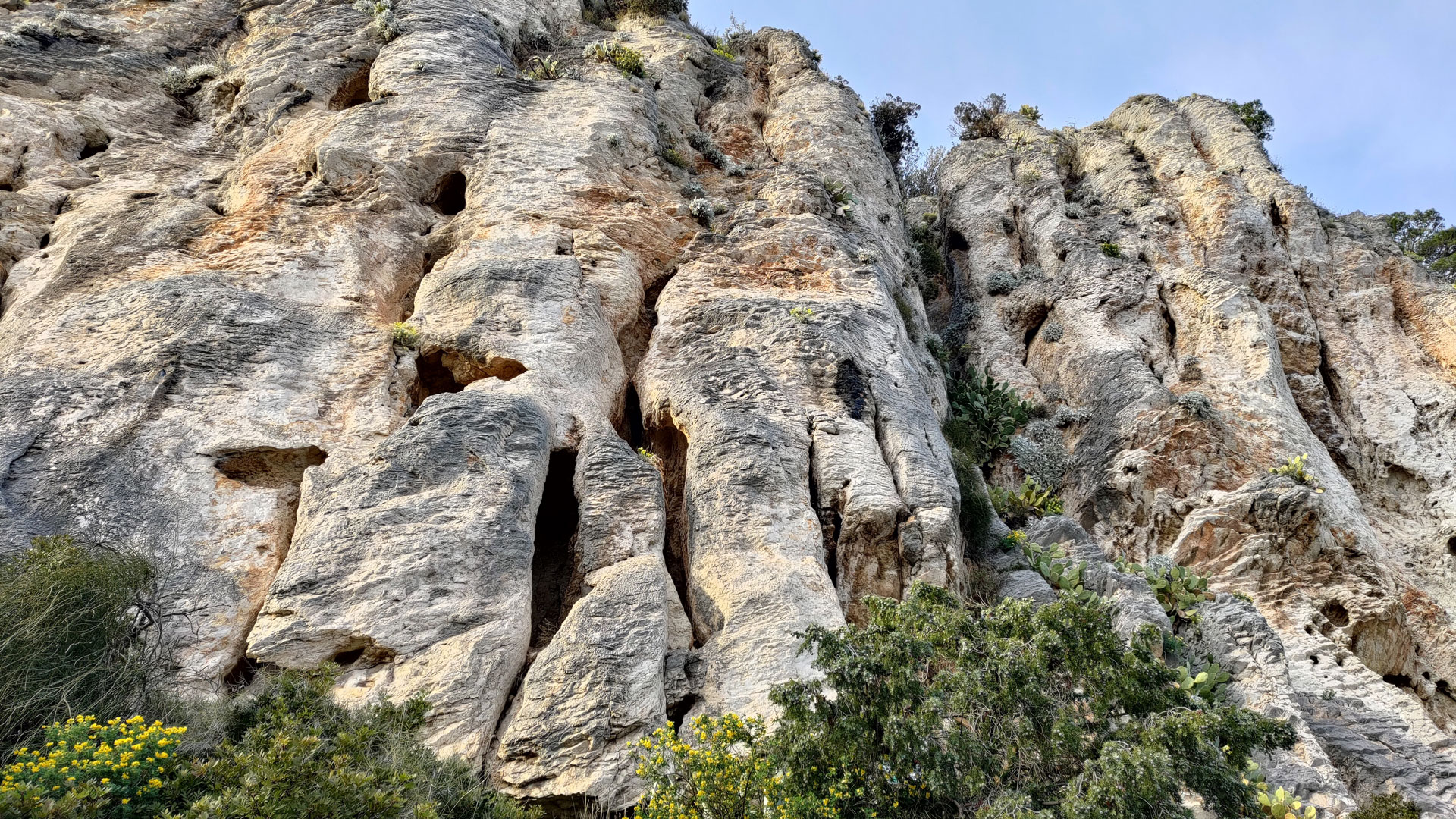
These cliffs host numerous climbing routes that draw climbers from all over the world year-round. In the dead of winter, it can be pleasant here in short sleeves, enjoying the sun and the spectacular views.
Hermitages (hermit dwellings) are carved into Šantine Stine, making for an extraordinary sight and a rarely seen attraction on a global scale!
Church of Sv. Jere (St. Jerome)
It was built in the 15th century on the site of the former Church of St. Cyriacus.


In front of the church there is a small plateau with a cistern (gustirna) and a stone wall lined with benches. It is an ideal place for resting and reflection.
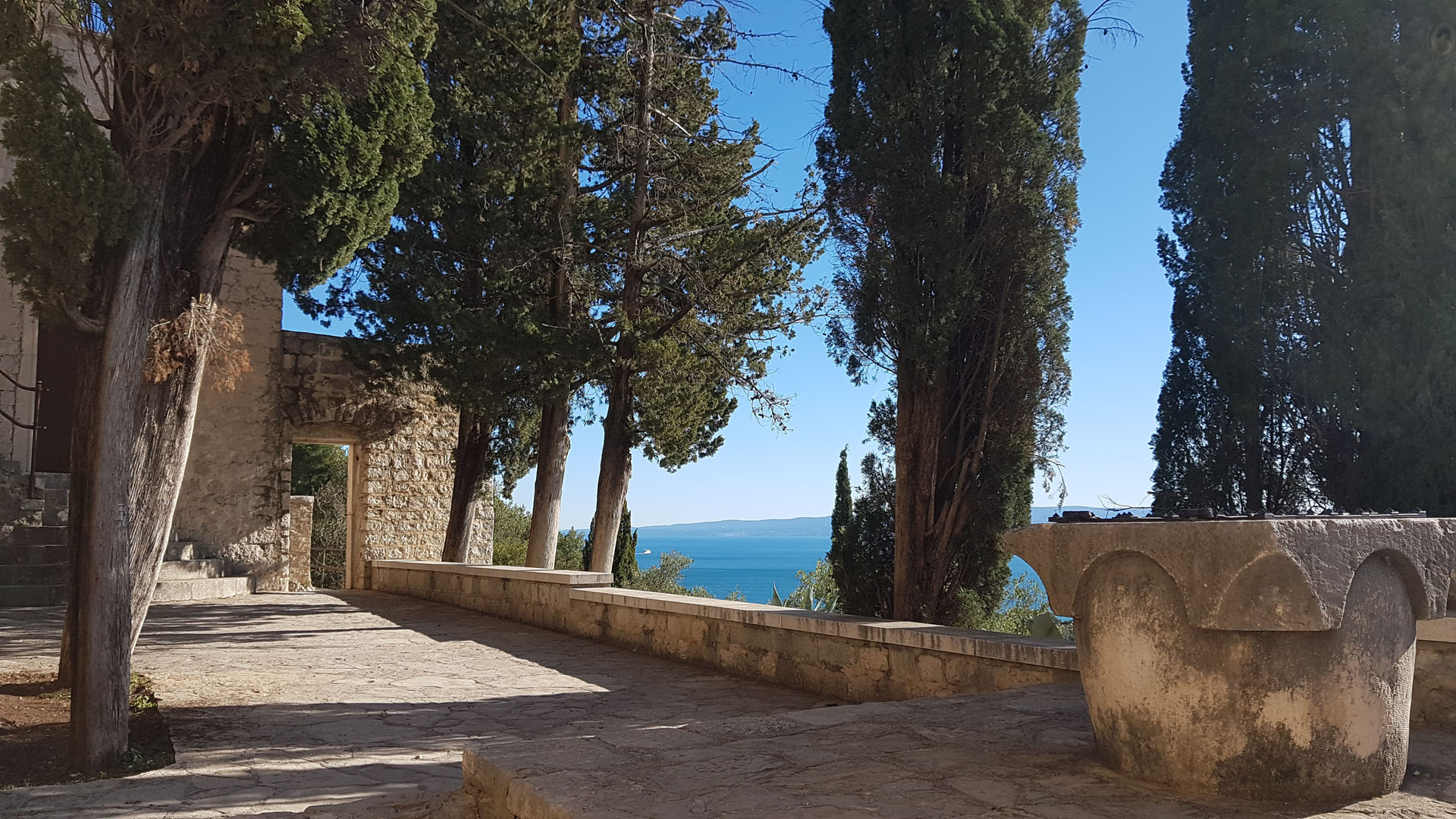
Gorgeous views of the sea and the islands, shelter from the wind, a special energy and a wistful atmosphere make this place truly extraordinary! For me personally, it is at the top of the list of a handful of the most beautiful places in the world!
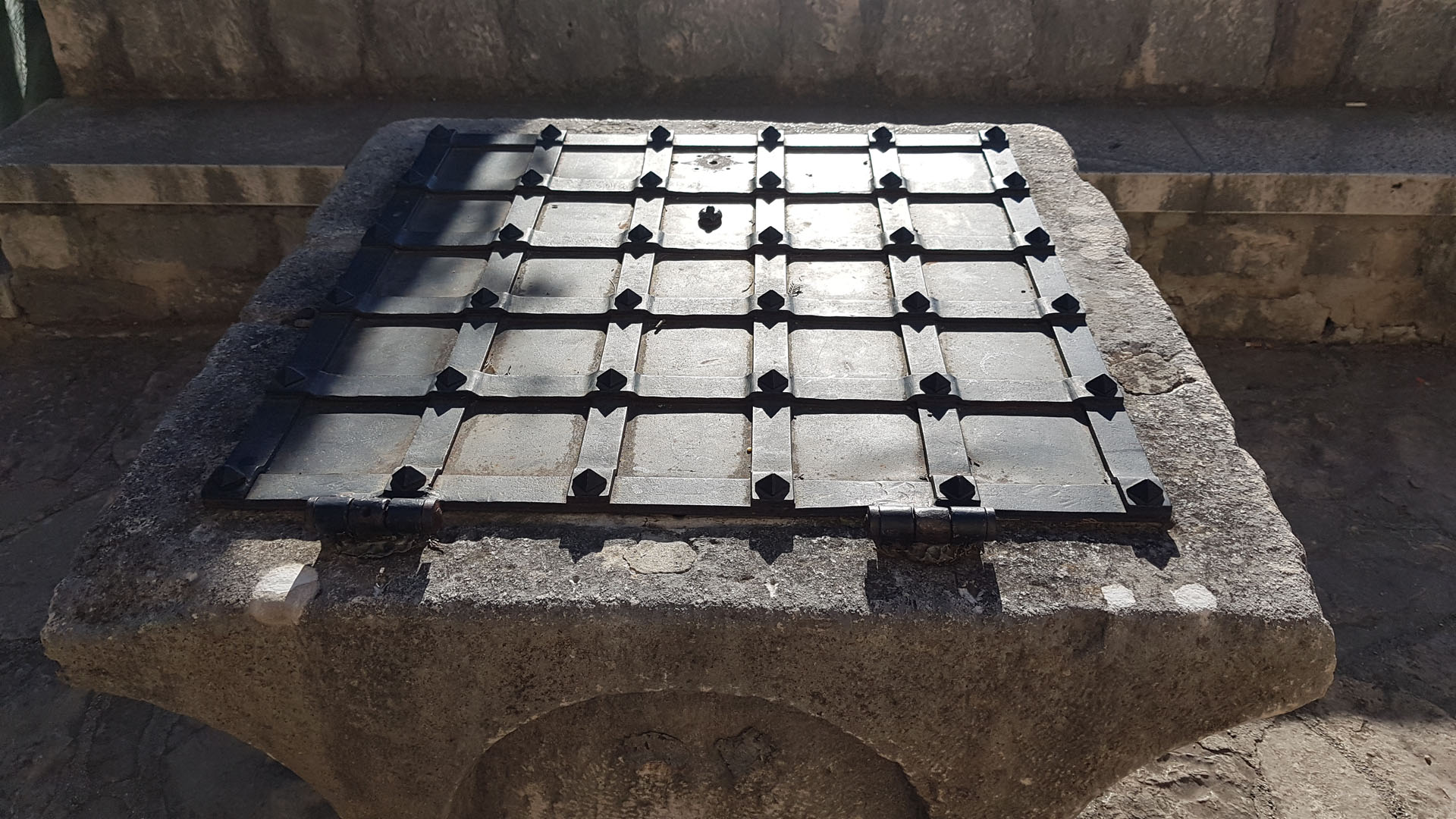

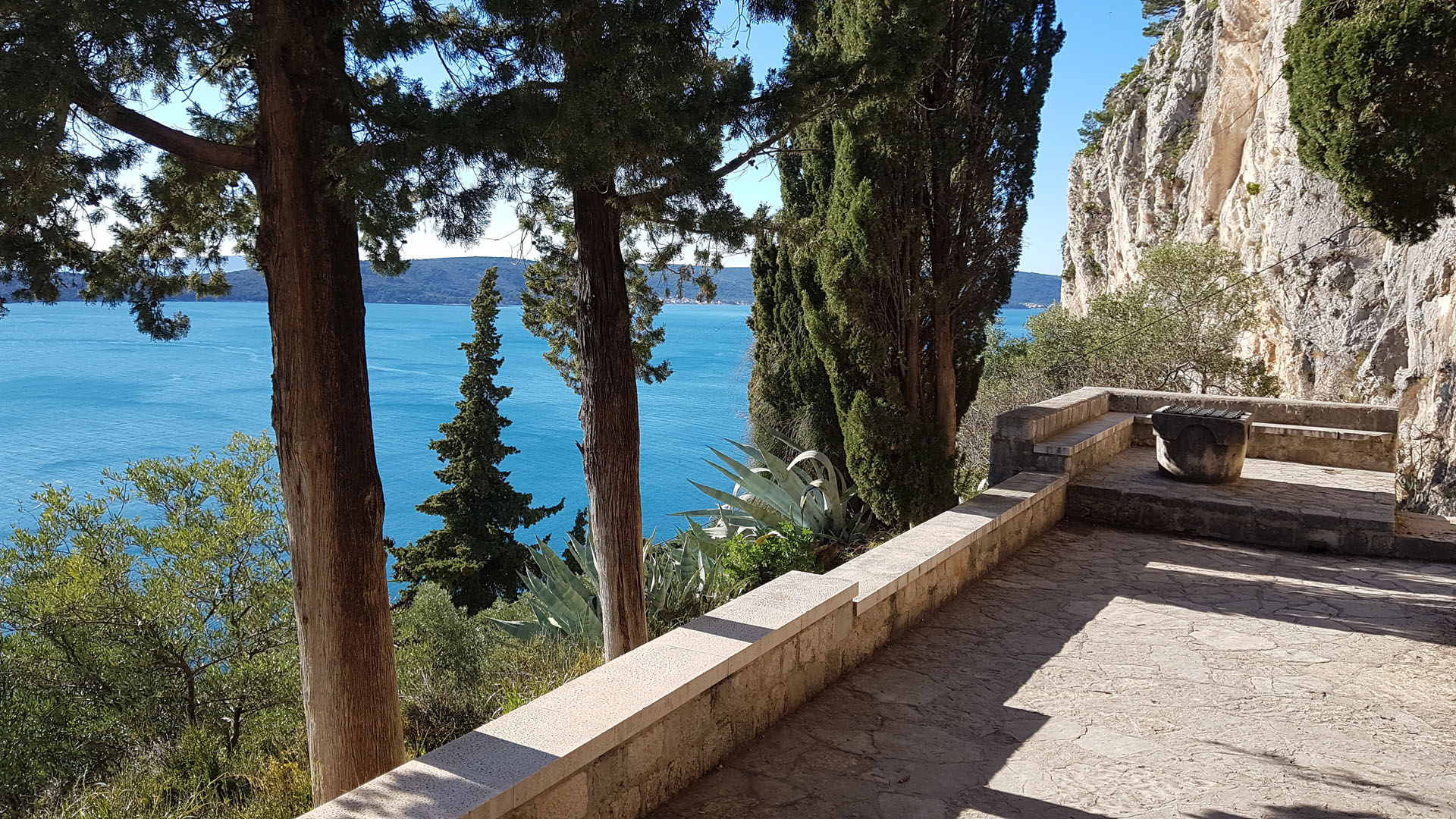


Beyond its unique location, the chapel’s main feature is its combination of Gothic and Renaissance styles.
The church opens its doors only very rarely. So far, this has mainly happened on the Night of the Museums and on the feast day of St. Jerome.


The Marjan Hermitages (Hermit Dwellings)
Carved into the cliff next to the Church of Sv. Jere is a medieval hermitage (hermit cave), restored in the second half of the 15th century. According to legend, St. Jerome and St. Cyriacus once resided there.
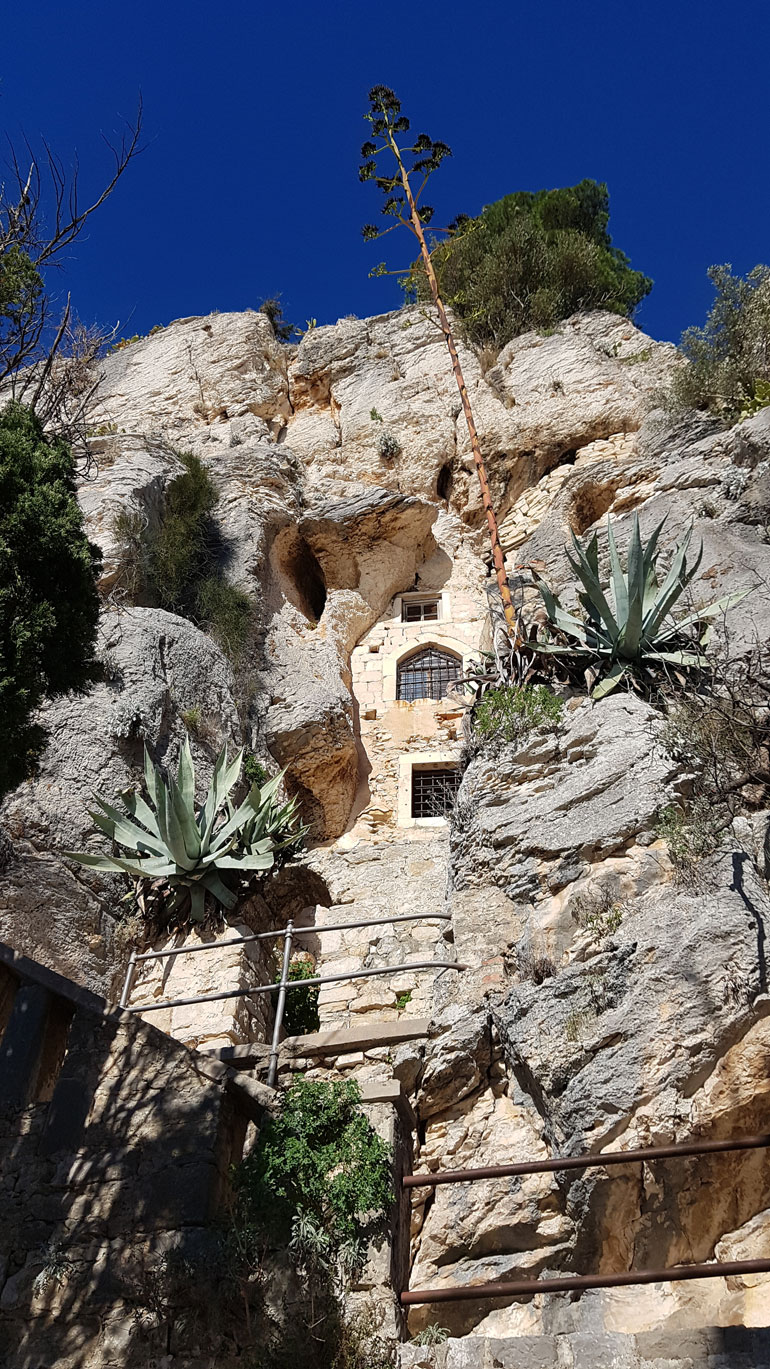
In times past, this was a remote spot. From Split, it was not easy to reach. Sheltered and isolated, it was an ideal place for the ascetic life of hermits. A place of indescribable beauty, a location that takes your breath away, where contemplation comes naturally.

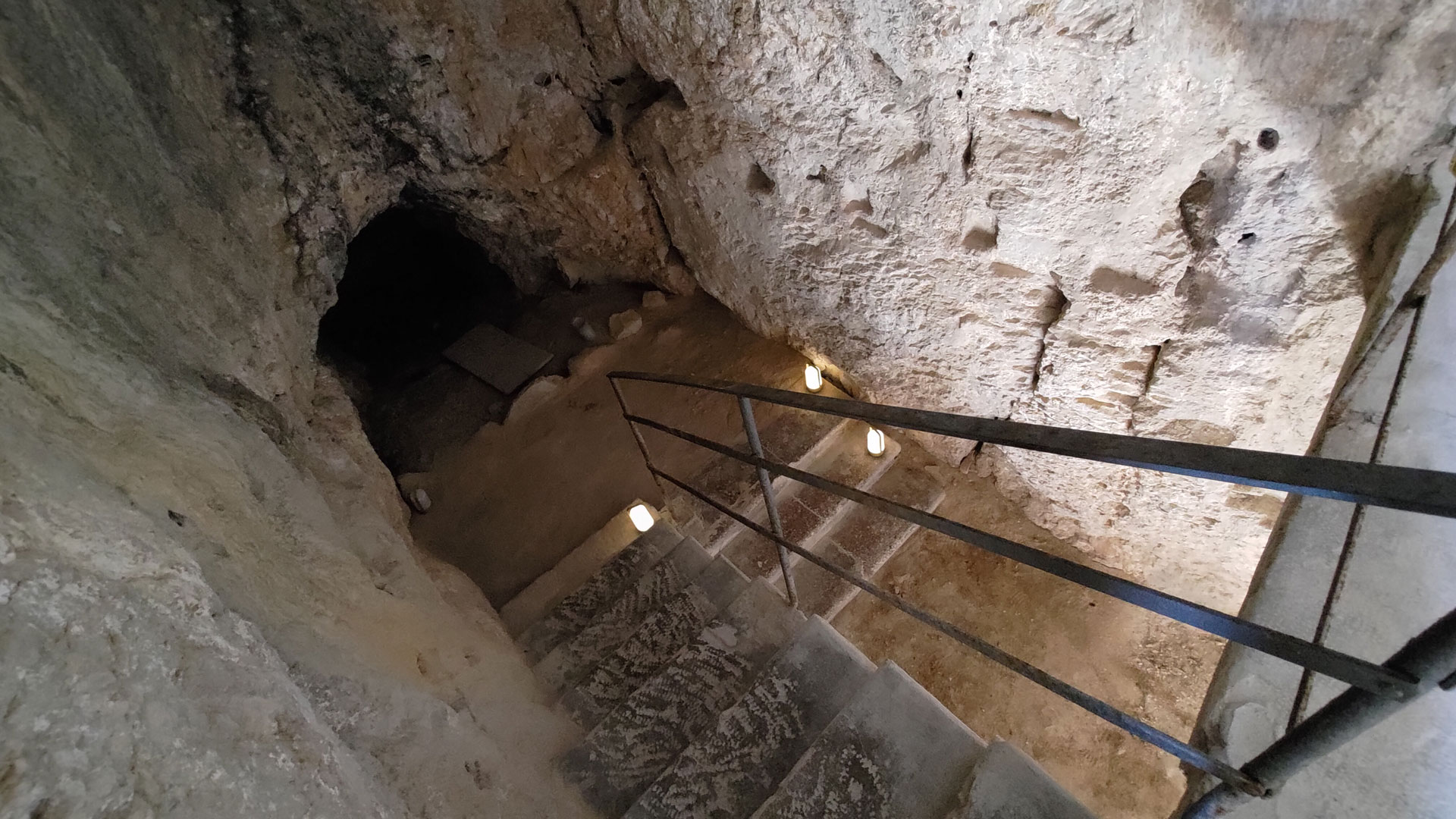
The hermitage has occasionally been open to visitors on the Night of the Museums and the feast day of St. Jerome.


Karepić Tower
In a gap in Šantine Stine, near the hermitages of Sv. Jere, stands a tower from 1523. It was used to shelter and defend farmers in the fields in the event of pirate or Turkish attacks. Above the entrance is the coat of arms of the Karepić family, with the Latin inscription “For the united, vows are granted; the disunited labor in vain — 1523.”

Church of Our Lady of Bethlehem (Gospe od Betlema)
Built around 1500, it was named after a 15th-century Renaissance relief of the Nativity. It stands on the southern slopes of Marjan, below the fire observation tower.
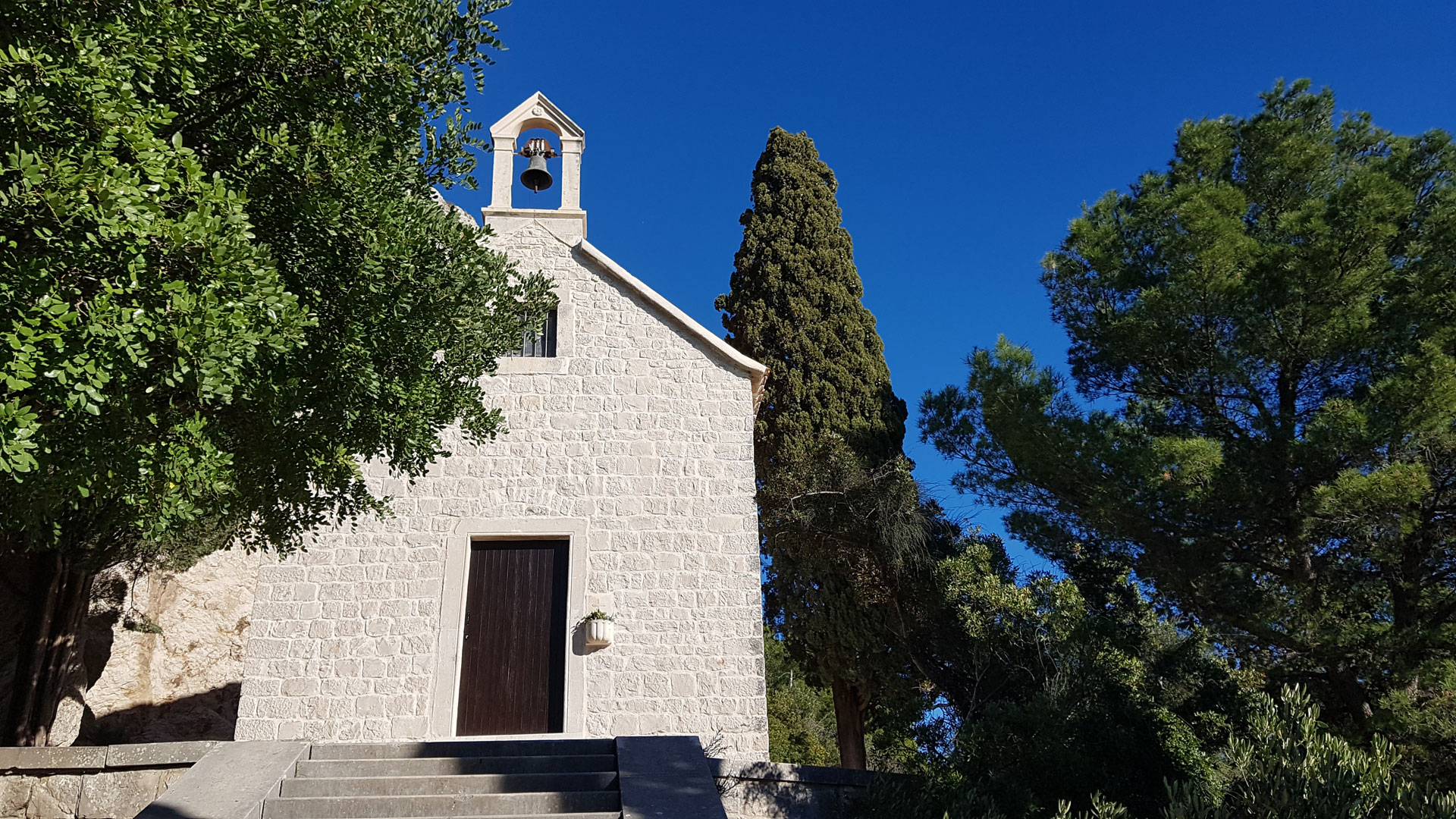
Every year on Christmas Eve, the earliest Midnight Mass is held here at 4 PM. If the weather is good, the purple sunset and the atmosphere make the entire experience unforgettable!

Church of Our Lady of the Seven Sorrows (Gospe od sedam žalosti)
This little church is set on the southern slopes of Marjan, in the forest above Kašjuni. It was built in the 15th century on an older shrine from 1362. Inside is a relief by Juraj Dalmatinac.

Its walls are full of prayers and vows written by visitors.


Church of Sv. Nikole (St. Nicholas)
A votive church on the path from Prva Vidilica toward Sedlo (to the left) and the Zoo (to the right). Construction began on January 13, 1219; it was commissioned by Rako, a citizen of Split, and his wife Elizabeta.


Church of Sv. Jurja (St. George)
Built at the start of the 9th century, it sits on the Marjan point near the Institute.

Jewish Cemetery
The cemetery is located right behind Prva Vidilica, enclosed by a high wall. It dates back to 1573, when the Venetian authorities granted the land to the Jewish community. Today it is designated a cultural monument of the first category.
Bambina Glavica
A rise on the southern slope of the Marjan hill. Remains of human life from prehistoric times have been found here.

Kašjuni
The most beautiful bay in Split, looking out at Šantine Stine and the southern side of Marjan, was always an oasis of peace and quiet.

That changes drastically in summer, when chaos descends after 9 AM. The bay has been systematically devastated over the past 10 to 15 years. The beach that was once beautiful has been ruined by illegal nourishment with industrial stone and crushed rock meant for graves. The peace of the bay was wrecked by the construction of two ugly, noisy hospitality venues whose concessions were obtained through corruption — and for which demolition orders have since been issued. An illegal dock has been built, where boat tours with foreign tourists dock. Existing parking lots for locals are blocked, and a section of dense pine forest with century-old trees has been devastated by illegal logging. With the arrival of Uber, total traffic chaos sets in: drivers block the passages like vultures, waiting for some tourist to grow tired of the commotion and decide to head back to the city. Large portions of the beach are taken over by sun-loungers that no one needs, except perhaps drunken foreigners who roll around on them and pose for Instagram.
Man has always been nature’s worst enemy. When someone mentions Kašjuni as the most beautiful beach, that is only fond memory talking. The bay, yes — but the beach, no longer.
At the far western end of the bay, where the rocks begin in the sea, lies the nudist section of the beach. It can also be reached via goat tracks from the road approaching the Southern Ramp.
Vila Dalmacija
Vila Dalmacija lies between the Kaštelet and Kašjuni. It is a fenced complex not fully open to the public. The villa was built at the beginning of the 20th century by the entrepreneur Franjo Schiller. After World War II it was taken over by the communists, who made it famous as “Tito’s villa.” At that time it was a strictly guarded military installation. After the fall of communism, the complex fell into disrepair. It was saved from total ruin by its current main role — hosting glamorous weddings.
Inside the complex is also the Mediterranean Institute for Life Sciences, founded by the renowned Croatian scientist Dr. Miroslav Radman.
Meštrović Gallery and Kaštelet
Two extraordinary places… A very unfriendly lady at the entrance refused to allow photography, claiming some sort of special permit was required. I would call that a usurpation of public property, since Meštrović did not bequeath his legacy to clerks and bureaucrats, but to the Croatian people. Since there are no decent photographs of the buildings on the official website (which is shameful, but typical of public sinecures), we have no material for this section.

The entrance to the Meštrović Kaštelet is on the side of the road, and the ticket for the Meštrović Gallery tour also serves as admission to the Kaštelet.
Ježinac, “Obojena”, Kaštelet
This is one of Split’s iconic bays! It contains two large beaches. Many will use one of the three names in the heading for the whole bay, but the bay’s topography supports the coexistence of all three names.
If we approach from the east, from the direction of Jadran and Zvončac, most people call the first “bay within the bay” Ježinac. One of the most beautiful seaside promenades leads here. It is especially popular in winter, since it is sunny and largely sheltered from the Bura wind.


After Ježinac comes the beach most people call Obojena, after the former café and nightclub “Obojena svjetlost” (“Colored Light”).

Although today only ruins remain of that legendary youth gathering place, the name of the beach — and often of the entire bay — has stuck. Here you will find the finest pebble shore in Split, and in places even sand, where children build castles.
Obojena was once the site of some of the best summer concerts, so it has a special place in the hearts of generations of Split natives.
Next to it is a large concrete platform, which fills up in summer to the last spot!

Further to the west lies the beach most people call Kaštelet, after Meštrović’s Kaštelet on the cliff above.

Sustipan

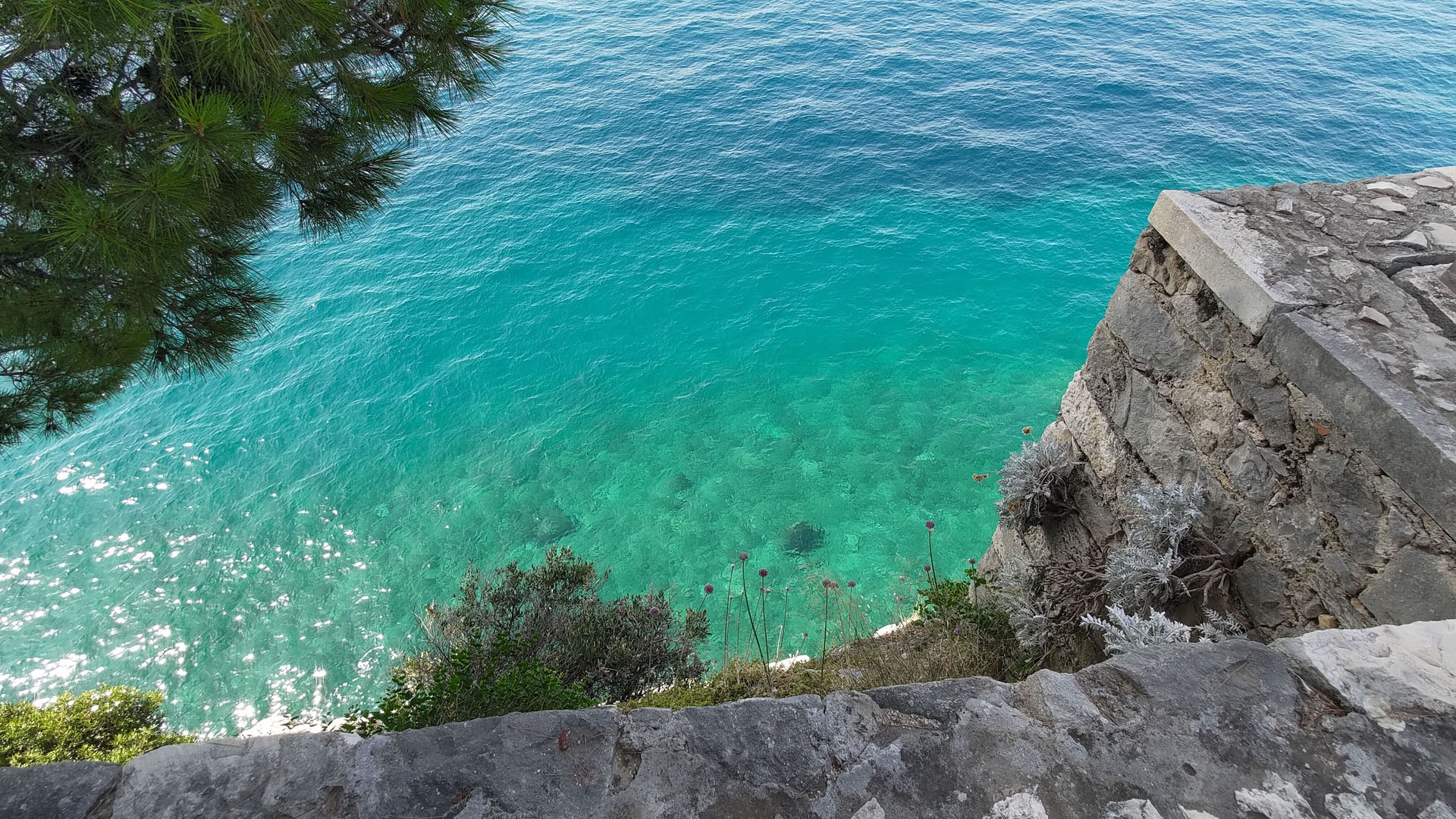
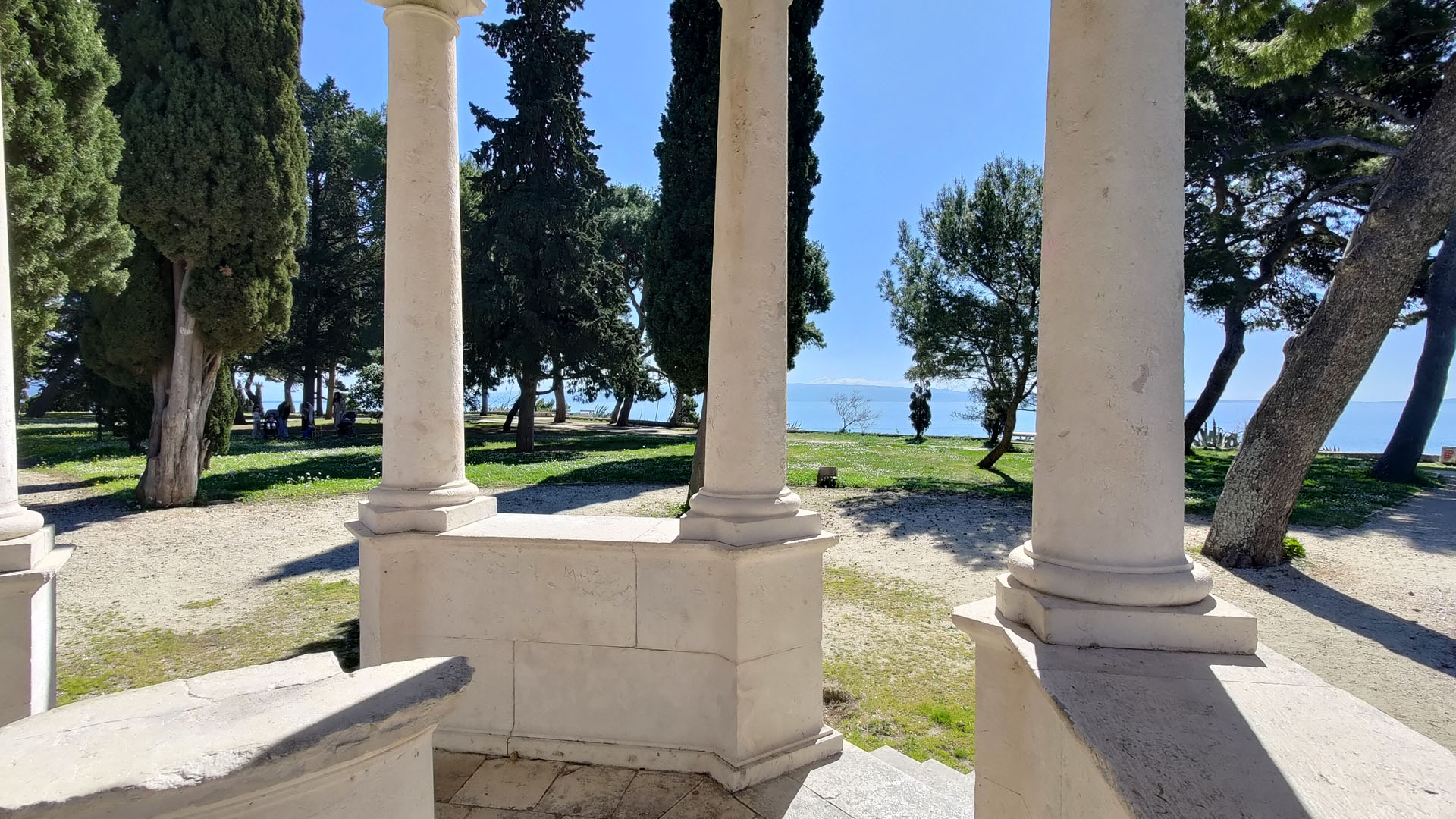
Sustipan is one of the most beautiful locations in Split — and, we feel free to say, in the world. Today it is a stunning park of century-old pines, with spectacular views over the sea and the Split Gate (the strait between Brač and Šolta).

Sustipan has a rich history and great significance for Split and its citizens. From the year 1020, Sustipan was the seat of the Benedictine abbey of St. Stephen the Protomartyr. The monastery was founded and built by the citizens of Split, who had the right — after the bishop and the count — to participate in the election of the abbot, the most distinguished citizen of Split.

The abbey reached its peak during the time of the Split archbishop Lovre, and its most famous resident and monk was the last Croatian king of the Trpimirović dynasty, Stjepan II. He is believed to have been buried at Sustipan.

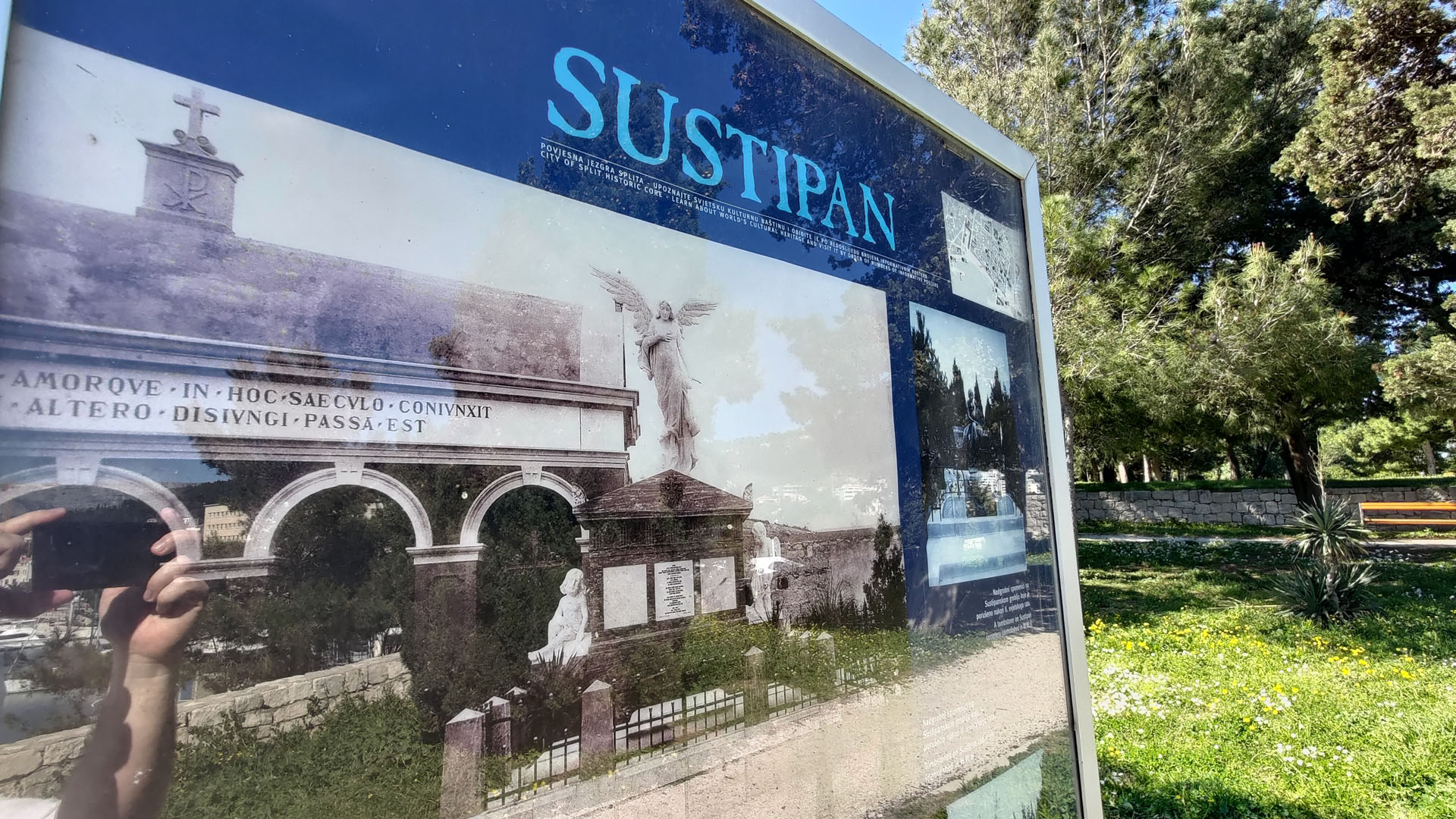
The monastery slowly declined from the 14th century, when it was also abandoned. In 1832 it was finally demolished, and the city administration turned the site into a cemetery. The cemetery existed until the end of World War II, when it was relocated to Lovrinac.
This is a place of great beauty and reverence. Together with the park at Zvončac it is one of the most beautiful locations in Split and a favorite destination for citizens seeking peace in nature.


Sustipan is also a beloved gathering place for young people in every season.
Apart from its beauty and hidden corners, Sustipan also offers challenges. In summer, the bravest put their courage to the test here with jumps into the sea!

For many years now, Sustipan has hosted summer concerts as part of the Split Summer Festival and “The Dream of a Sustipan Night.” At first these events were discreet, but later a few noisier, less appropriate concerts were held, raising considerable debate and drawing condemnation from parts of the public. Memories of the graves of loved ones are still strong, so the line between “appropriate” and “inappropriate” is very “delicate” here.
The problem is all the greater because many bones from the burials remained on Sustipan — the exhumation was carried out very sloppily. During the strongest Bura in the 1990s, when some trees were uprooted, the roots pulled bones up out of the ground along with them.
That is why Sustipan should not be turned into a spectacle, but should remain a place of reverence and a beautiful park open to everyone who seeks a little beauty and peace.

Zvončac

A park and a neighborhood of Split at the foot of Marjan. Together with Jadran and Sustipan, it forms an inseparable whole and the most beautiful part of Split. Zvončac is always full of children and young people.

In spring, the meadows are full of flowers, so Zvončac turns into the most beautiful destination for picnics and outdoor get-togethers. Birthday celebrations are often organized here in the open air.


Jadran

Jadran as a toponym takes its name from the hotel of the same name, perfectly nestled at Zvončac below Sustipan. Known as a sports hotel, it has two pools — one of them Olympic-sized.

It is home to the Jadran water polo club. The venue has hosted many events, one of the most famous being the Melodije hrvatskog Jadrana (“Melodies of the Croatian Adriatic”) festival. Going to Jadran does not necessarily mean going to the pools or the stands. Jadran once had a legendary gym, one of the few in town. On the outside there is also a popular concrete swimming area — the only paid swimming spot in Split.

On the point of Jadran is a café where you can enjoy the sun in a unique setting even in the middle of winter, and right next to it, beneath the walls of Sustipan, is the legendary “mali balun” (small football) pitch, where many famous players honed their skills!


Tomića Stine

The sea once lapped at these rocks adorned with picturesque little houses. Matejuška is a natural bay, the closest to the city, so it is no wonder that the oldest fishermen’s harbor (mandrač / mandroč) is here. The bay is framed by two ridges — Tomića Stine and Solurat. Behind them stretches one of the oldest parts of Split — Varoš. Varoš climbs up Marjan all the way to Prva Vidilica. Nearby is the famous Križeva Kala and one of the oldest churches — the Church of Sv. Mikule (1068). On the other side, Varoš is bounded by the legendary gasworks (now Plinarska Street) and Stari Plac, the old playground of Hajduk. Just behind Tomića Stine (to the west) begin the legendary Marjan Stairs.
The Devastation of Marjan
It is inconceivable that a location like Marjan represents a “thorn in the side” to some. A greedy construction lobby, the petty interests of conscience-less individuals, and the incompetence and corruption of entrenched bureaucrats continuously “gnaw away” at this global gem. One of the inglorious episodes in the devastation of Marjan occurred in 2019. Through systematic neglect, an infestation of bark beetles threatened to dry out the forest. It is not impossible that they were deliberately introduced so that the forest could be cut down — which would have stripped Marjan of its protected status and turned it into a target for construction.
The originally planned felling of 20,000 trees turned into outright ecocide. With no oversight, in the most opaque manner, and with favors granted to various interest groups, over 45,000 trees were cut down. Independent experts who carried out covert oversight claim that more than half the trees were healthy. Entire parts of Marjan were literally stripped bare. Today, if you walk from the Northern Gate toward Bene, you will mostly be exposed to the sun. All of it used to be deep shade.
The negligence was witnessed by all citizens, and it was obvious. Felled trees left for months without their bark stripped (the bark is where the beetle lives), too few pheromone traps that were never replenished, and debris scattered throughout the forest told even laypeople everything about the collusion between the then-director of the public institution Park-Forest Marjan, corrupt city authorities, and mafia-linked interest groups.
With the change of government, the damage on Marjan has begun to be repaired, but it will take decades for Marjan to heal its wounds and shine again in its full glory. This is a lesson to everyone about how far human greed is willing to go in its assault on common sense and the greatest values we inherit.
Special
Although our focus is on Croatia, due to great interest in reviewing some international locations from our travels, we decided to launch the Special section. In it, we will not cover locations in the same detailed way we do with Croatian ones, but will instead provide a brief overview of multiple locations grouped into meaningful categories. The only criterion we still strictly follow is that they must be natural attractions.